
Preloader

Meniscus Tears

Meniscus Tears and Knee Injuries

Meniscus tears are among the most common knee injuries seen in both athletes and non-athletes.

Although athletes involved in contact or pivoting sports are at higher risk, meniscus tears can occur at any age—sometimes even during simple daily activities.

Knee Anatomy – What Is the Meniscus?

The knee joint is formed by:

  • Femur (thigh bone)
  • Tibia (shin bone)
  • Patella (kneecap)

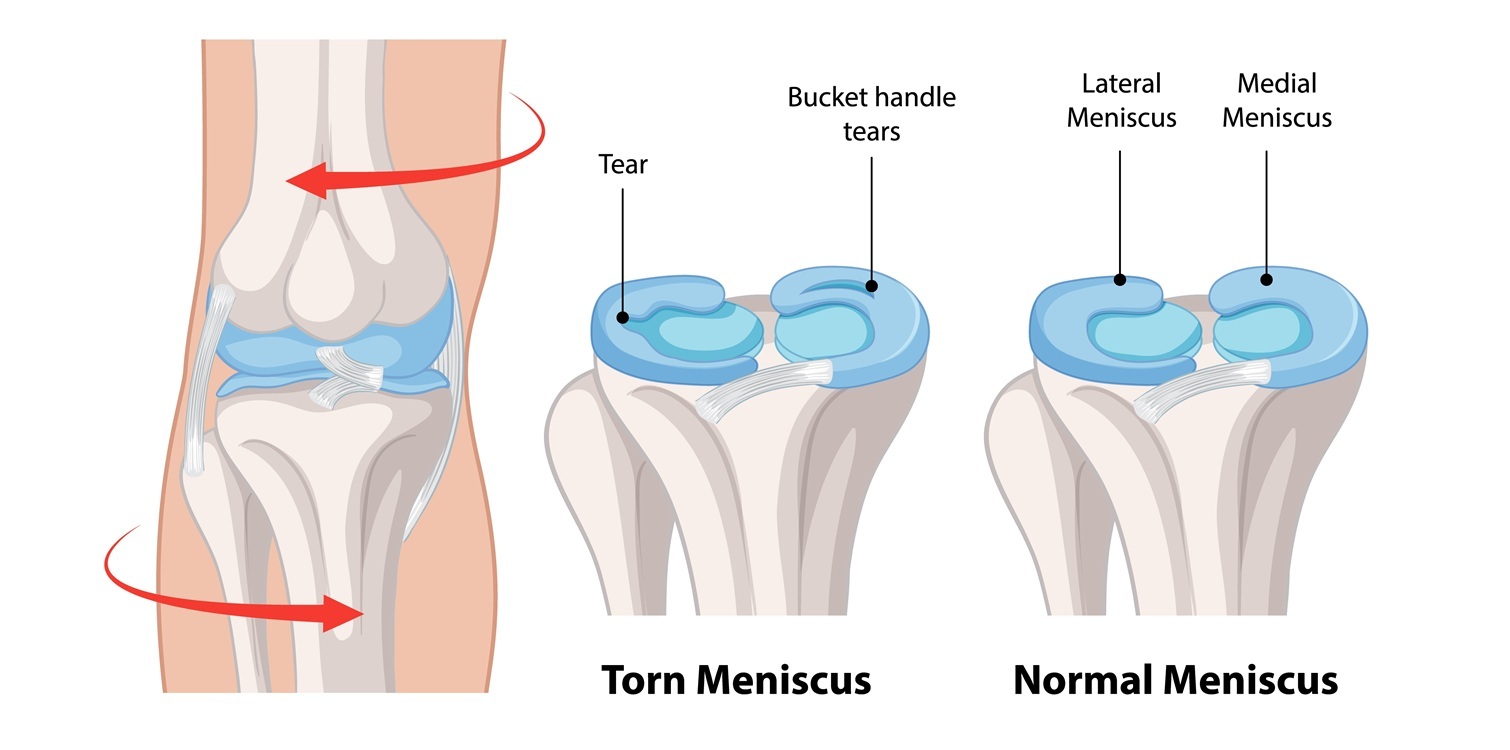
Between the femur and tibia are two C-shaped fibrocartilage structures called the menisci (medial and lateral meniscus).

Functions of the Meniscus

  • Act as shock absorbers
  • Distribute body weight across the knee
  • Improve joint stability
  • Protect the cartilage from early arthritis

Types of Meniscus Tears

Meniscus tears are classified based on shape and location. Common types include:

  • Bucket handle tears
  • Flap tears
  • Radial tears
  • Degenerative tears

Sports-related meniscus injuries often occur along with other knee injuries, especially ACL tears.

Causes of Meniscus Tears

Acute (Traumatic) Tears

  • Sudden twisting or pivoting
  • Cutting movements during sports
  • Direct contact injuries

Degenerative Tears

  • Occur due to age-related wear and tear
  • The meniscus becomes weaker over time
  • Even a simple movement like getting up from a chair can cause a tear

Symptoms of a Meniscus Tear

  • A popping sensation at the time of injury
  • Knee pain
  • Swelling and stiffness (usually develops over 1–3 days)
  • Catching or locking of the knee
  • Sensation of the knee giving way
  • Difficulty fully bending or straightening the knee

Many people can initially walk on a torn meniscus, but symptoms often worsen over time.

Doctor Evaluation & Diagnosis

Physical Examination

Your doctor will:

  • Examine for joint line tenderness
  • Assess knee movement and stability
  • Perform special tests such as the McMurray test, which may cause pain or clicking if a tear is present

Imaging Tests

  • X-rays: Rule out arthritis or bone problems
  • MRI: Gold standard for diagnosing meniscus tears
    • Shows the size, type, and location of the tear
    • Helps identify associated ligament or cartilage injuries
  • CT arthrogram or ultrasound: Used if MRI is not possible

Treatment of Meniscus Tears

Treatment depends on:

  • Age
  • Activity level
  • Symptoms
  • Tear size, type, and location

Blood Supply Matters

  • Outer one-third (red zone): Good blood supply → may heal or be repaired
  • Inner two-thirds (white zone): Poor blood supply → usually does not heal on its own

Non-Surgical Treatment

Many meniscus tears do not require immediate surgery, especially if there is no locking or persistent swelling.

Conservative Management Includes:
  • RICE protocol
    • Rest
    • Ice
    • Compression
    • Elevation
  • Pain medications (NSAIDs)
  • Activity modification
  • Physiotherapy
  • Steroid injections (selected cases)
  • Biologic treatments (PRP) – still under evaluation

Surgical Treatment

Surgery is considered if:

  • Pain persists despite conservative care
  • Knee locking or instability is present
  • Tear interferes with daily activities or sports

Arthroscopic Knee Surgery (Keyhole Surgery)

Partial Meniscectomy
  • Damaged portion of meniscus is trimmed
  • Quick recovery
  • Early weight bearing and movement allowed
Meniscus Repair
  • Torn meniscus is stitched back together
  • Preserves meniscus and protects the knee long term
  • Longer recovery (3–6 months)
Meniscus Transplant
  • Considered in young, active patients with near-complete meniscus loss
  • Uses donor meniscus tissue
  • Helps delay knee arthritis

Rehabilitation & Recovery

  • Physiotherapy is essential after surgery
  • Range-of-motion exercises begin early
  • Strengthening added gradually
  • Recovery time:
    • Partial meniscectomy: 3–6 weeks
    • Meniscus repair: 3–6 months
  • With proper care, most patients return to their pre-injury activity levels.

Why Choose ArthroSportz Med for Meniscus Treatment?

At ArthroSportz Med, we specialize in sports knee injuries and advanced arthroscopic care, with a strong focus on preserving knee health and preventing early arthritis.

Our Advantages:

Expertise in arthroscopic meniscus surgery

Emphasis on meniscus preservation and repair whenever possible

Advanced MRI-based decision making

Integrated management of ACL and cartilage injuries

Sports-specific rehabilitation protocols

Personalized treatment for athletes and non-athletes

Focus on long-term knee function and injury prevention

Our goal is not just to treat the tear—but to protect your knee for the future and help you return
confidently to work, sports, and daily life.

Restoring strength and mobility with trusted hands for over 10 years.

12+ Years of Care

Specialising in shoulder & knee care, arthroscopy, sports injuries, and trauma.

Joint & Sports Care

Frequently Asked Question

In most cases, you can begin physiotherapy without a doctor's referral; however, some insurance providers may require one for reimbursement or coverage purposes.

In most cases, you can begin physiotherapy without a doctor's referral; however, some insurance providers may require one for reimbursement or coverage purposes.

In most cases, you can begin physiotherapy without a doctor's referral; however, some insurance providers may require one for reimbursement or coverage purposes.

In most cases, you can begin physiotherapy without a doctor's referral; however, some insurance providers may require one for reimbursement or coverage purposes.

Source/s: Banner Image – Freepik & is for representational purpose only.