
Preloader

Cartilage Restoration

Cartilage Restoration_Banner

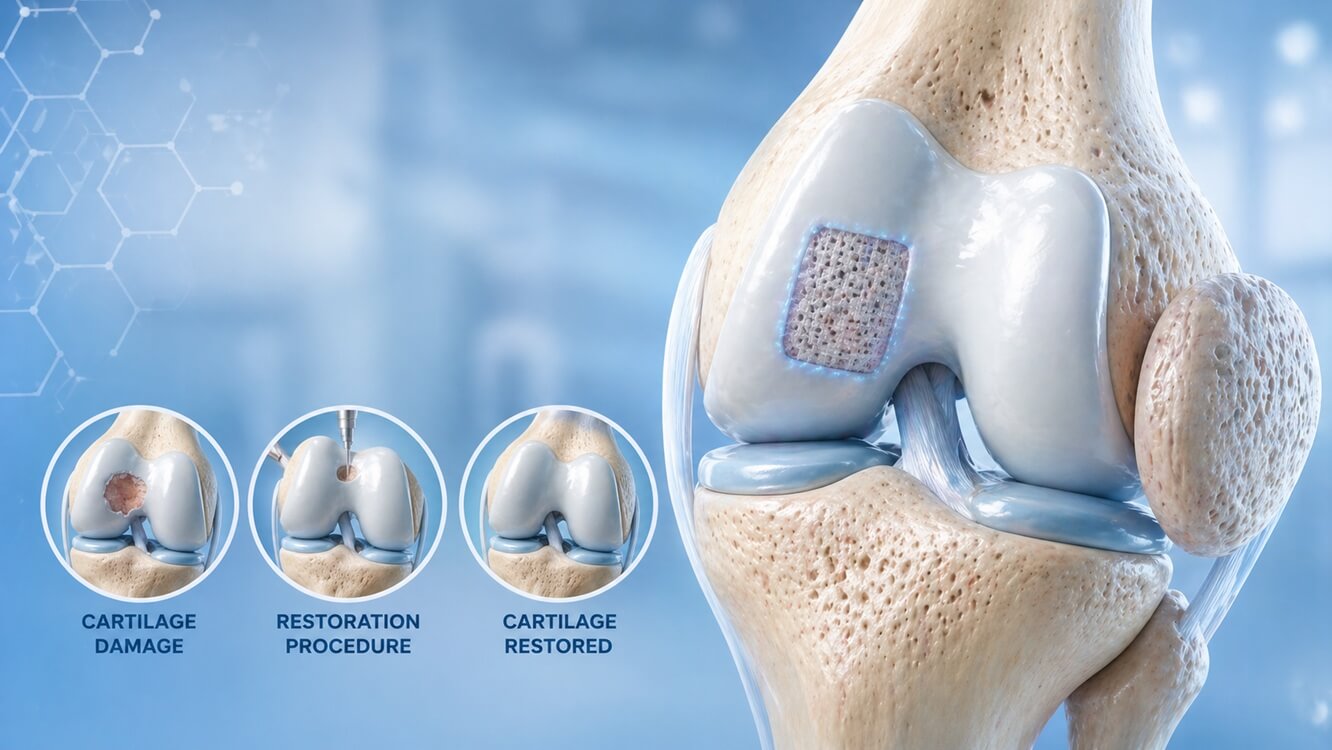
Articular cartilage is the smooth, white tissue covering the ends of bones in the knee and other joints. It allows pain-free movement and load transmission.

Cartilage has poor natural healing capacity, and untreated defects can progress to pain, swelling, mechanical symptoms, and early arthritis—even in young, active patients.

The goal of cartilage restoration is symptom relief, defect healing, and long-term joint preservation.

Cartilage Restoration Options

(1) Chondroplasty (Cartilage Smoothing)

  • Arthroscopic procedure to trim unstable cartilage flaps
  • Reduces pain and mechanical symptoms
  • Does not regenerate cartilage

Indication: Small, superficial cartilage lesions
Role: Symptom relief only (palliative procedure)

(2) BMAC Procedure (Bone Marrow Aspirate Concentrate)

BMAC uses the patient’s own bone marrow–derived cells rich in growth factors.

Procedure:

  • Bone marrow is aspirated (usually from the pelvis)
  • Concentrated and injected into the cartilage defect
  • Often combined with microfracture or scaffolds

Benefits:

  • Enhances biological healing
  • Minimally invasive
  • Improves pain and function

Best suited for: Early cartilage damage and focal defects

(3) OATS Procedure (Osteochondral Autograft Transfer System)

  • Transfers healthy cartilage and bone plugs from a non-weight-bearing area to the defect
  • Provides immediate hyaline cartilage restoration

Advantages

  • Single-stage procedure
  • Durable cartilage repair

Best suited for:

  • Small to medium focal cartilage defects
  • Young, active patients

(4) ACI Procedure (Autologous Chondrocyte Implantation)

ACI is an advanced two-stage cartilage restoration technique.

Stages:

  • Arthroscopic harvesting of healthy cartilage cells
  • Laboratory expansion and re-implantation into the defect

Advantages:

  • Regenerates hyaline-like cartilage
  • Excellent long-term outcomes

Best suited for:

  • Large cartilage defects
  • Young patients with preserved joint alignment

(5) Realignment Procedures (Corrective Osteotomy)

Cartilage restoration may fail if joint alignment is abnormal.

Purpose:

  • Redistribute load away from damaged cartilage
  • Protect cartilage repair procedures

Common procedures:

  • High tibial osteotomy (varus knees)
  • Distal femoral osteotomy (valgus knees)

Often combined with: OATS, ACI, or biological procedures

Procedure Selection – Not One Size Fits All

Cartilage treatment depends on:

  • Defect size and depth
  • Patient age and activity level
  • Limb alignment
  • Associated ligament or meniscus pathology

A stepwise, individualized approach is critical for success.

Rehabilitation & Recovery

Recovery varies by procedure:

  • Chondroplasty: 2–4 weeks
  • BMAC: 6–8 weeks protected loading
  • OATS: 3–4 months
  • ACI: 6–12 months
  • Osteotomy: Longer recovery with structured rehab

Why Choose ArthroSportz Med for Cartilage Restoration in Chennai?

Strong focus on joint preservation over joint replacement

At Arthrosportz Med, cartilage damage is treated early, scientifically, and comprehensively—to
preserve your natural joint for as long as possible.

Expertise in advanced cartilage restoration techniques

Individualized biological and surgical planning

Integration of alignment correction, ligament & meniscus care

Dedicated sports rehabilitation and return-to-activity programs

Sports-specific training: 5–6 months

Return to competitive sports: 8–9 months (after strength & stability assessment)

A dedicated sports rehabilitation program is key to success.
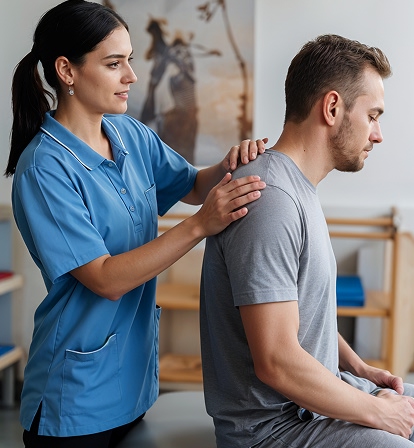
Restoring strength and mobility with trusted hands for over 10 years.

12+ Years of Care

Specialising in shoulder & knee care, arthroscopy, sports injuries, and trauma.

Joint & Sports Care

Frequently Asked Question

In most cases, you can begin physiotherapy without a doctor's referral; however, some insurance providers may require one for reimbursement or coverage purposes.

In most cases, you can begin physiotherapy without a doctor's referral; however, some insurance providers may require one for reimbursement or coverage purposes.

In most cases, you can begin physiotherapy without a doctor's referral; however, some insurance providers may require one for reimbursement or coverage purposes.

In most cases, you can begin physiotherapy without a doctor's referral; however, some insurance providers may require one for reimbursement or coverage purposes.

Source/s: Banner Image – AI Generated & is for representational purpose only.