
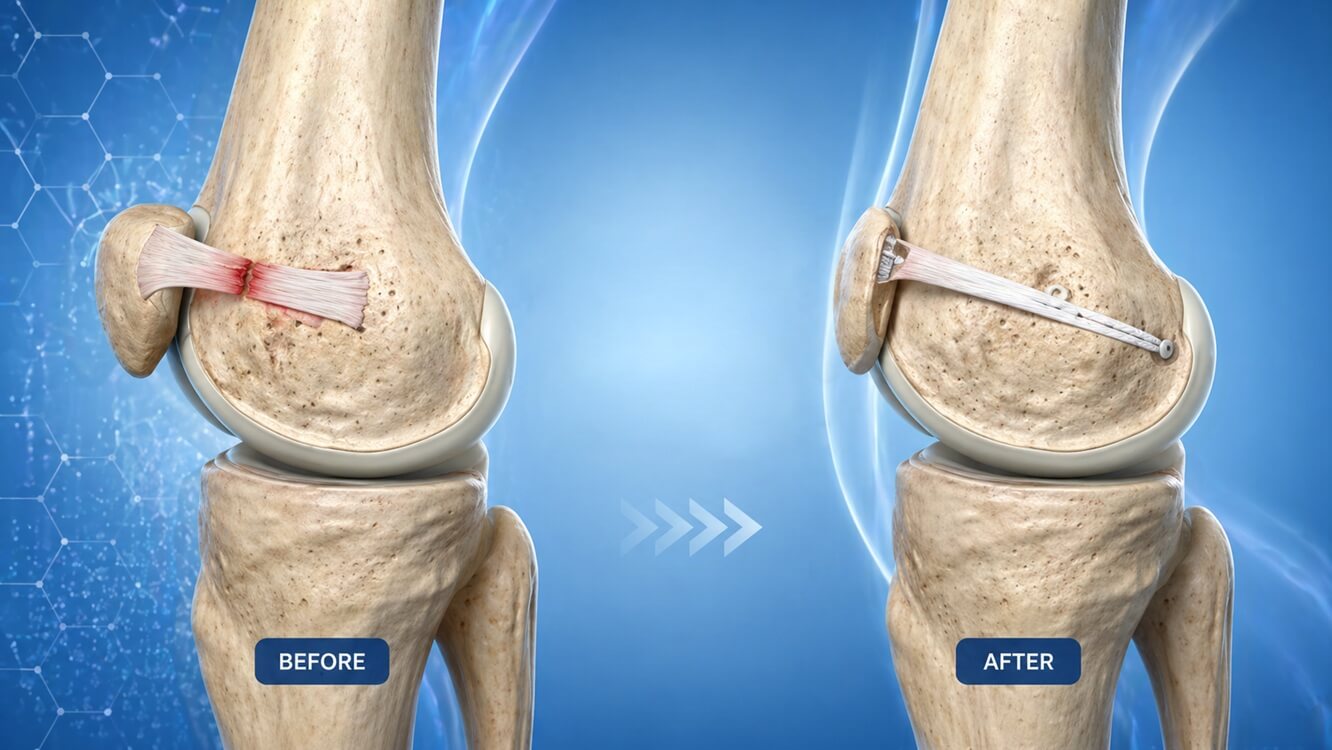
Patellar dislocation occurs when the kneecap slips out of its normal groove (trochlea), usually towards the outer side of the knee. It commonly affects young, active individuals and athletes.
Common causes include:
Recurrent patellar instability can lead to pain, repeated giving-way episodes, cartilage damage, and early arthritis if not treated appropriately.
Surgical stabilization is recommended in:
The goal of surgery is restoring normal patellar tracking and preventing further dislocations.
The Medial Patellofemoral Ligament (MPFL) is the primary restraint preventing lateral patellar dislocation.
Indications:
Procedure:
Reconstruction of MPFL using an autograft
Anatomic fixation to patella and femur
Restores medial stabilizing force to the patella
Key points:
MPFL reconstruction is the cornerstone procedure for recurrent patellar instability.
TTO addresses bony malalignment contributing to patellar instability.
Indications:
Procedure:
Often combined with: MPFL reconstruction for optimal stability.
Patellar instability is not a one-size-fits-all problem. Surgical planning is based on:
Isolated MPFL reconstruction is sufficient in some patients, while others require combined softtissue and bony procedures.
At ArthroSportz Med, patellar dislocation is treated with precision and planning—restoring stability, confidence, and long-term knee health.
12+ Years of Care
Joint & Sports Care
In most cases, you can begin physiotherapy without a doctor's referral; however, some insurance providers may require one for reimbursement or coverage purposes.
In most cases, you can begin physiotherapy without a doctor's referral; however, some insurance providers may require one for reimbursement or coverage purposes.
In most cases, you can begin physiotherapy without a doctor's referral; however, some insurance providers may require one for reimbursement or coverage purposes.
In most cases, you can begin physiotherapy without a doctor's referral; however, some insurance providers may require one for reimbursement or coverage purposes.
Source/s: Banner Image – AI Generated & is for representational purpose only.
Copyright © 2026 All Rights Reserved. Designed by Twitchtime.