
Preloader

Limb Realignment Surgery

Limb Realignment Surgery_Banner

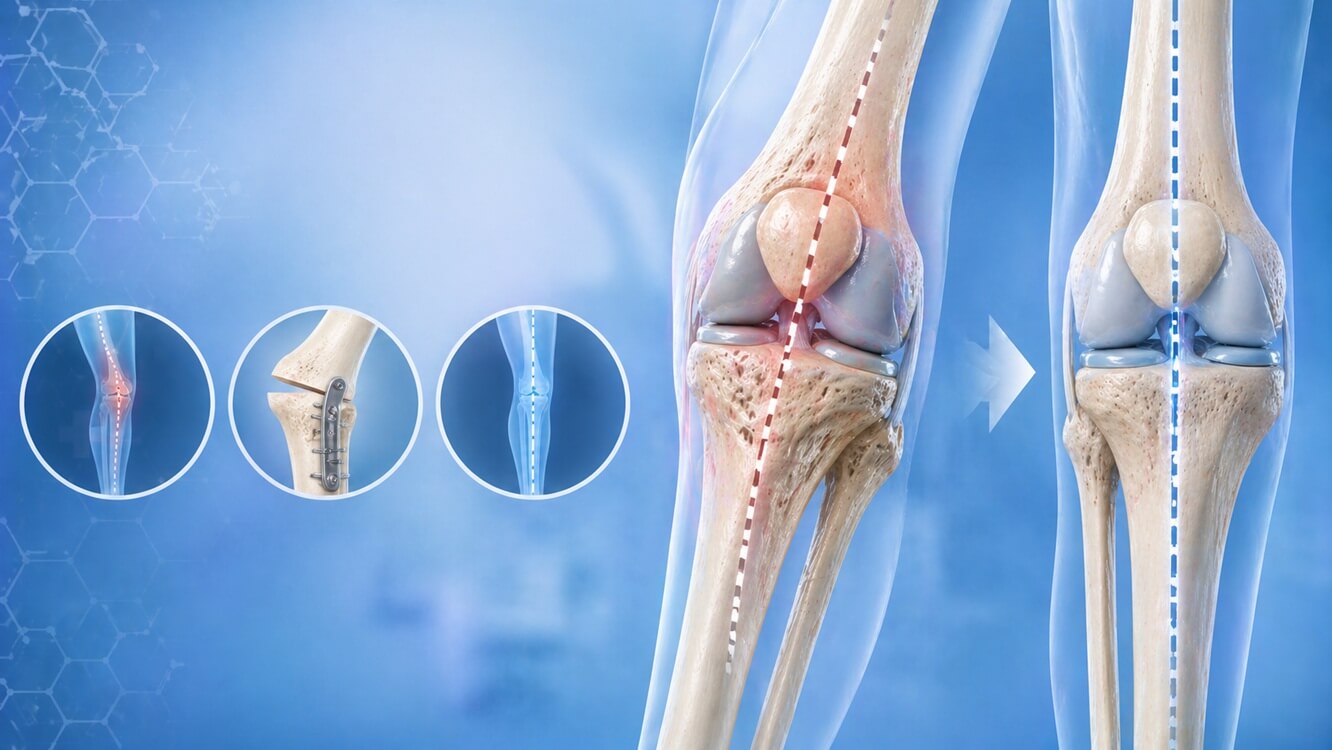
Abnormal knee alignment causes uneven load distribution across the joint:

  • Varus knee (bow-legged): Excess load on the medial compartment
  • Valgus knee (knock-knee): Excess load on the lateral compartment

Over time, this leads to cartilage wear, meniscus damage, pain, instability, and early arthritis, even in young and active patients.

Knee realignment surgery aims to shift load away from the damaged compartment, relieve pain, and preserve the natural knee joint.

Principles of Knee Realignment Surgery

  • Correct mechanical axis of the limb
  • Reduce stress on damaged cartilage or meniscus
  • Protect cartilage restoration and ligament reconstructions
  • Delay or avoid knee replacement

This is a joint-preserving procedure, not a joint replacement.

Types of Knee Realignment Surgeries

(1) High Tibial Osteotomy (HTO)

HTO is performed for varus-aligned knees with medial compartment overload.

Indications:

  • Medial compartment cartilage damage
  • Medial meniscus/root tears
  • Early medial compartment arthritis
  • Young or active patients

Procedure:

  • Controlled cut in the upper tibia
  • Opening or closing wedge correction
  • Fixation with plate and screws

Benefits:

  • Pain relief
  • Slows arthritis progression
  • Allows return to sports and active lifestyle

(2) Distal Femoral Osteotomy (DFO)

DFO is used for valgus-aligned knees with lateral compartment overload.

Indications:

  • Lateral compartment cartilage damage
  • Lateral meniscus/root tears
  • Valgus malalignment
  • Young, active individuals

Procedure:

  • Realignment at the distal femur
  • Opening or closing wedge correction
  • Stable fixation with plates

Benefits:

  • Restores joint balance
  • Preserves lateral compartment
  • Delays need for knee replacement

(3) Tibial Tubercle Osteotomy (TTO) – Alignment for Patellofemoral Disorders

While not a coronal plane osteotomy, TTO is a functional realignment procedure for patellar
tracking.

Indications:

  • Patellar instability
  • Patella alta
  • Increased TT–TG distance
  • Patellofemoral cartilage damage

Goal: Improve patellar tracking and reduce patellofemoral overload.

Realignment + Combined Procedures

Knee realignment is often combined with:

  • Cartilage restoration (BMAC, OATS, ACI)
  • Meniscal root repair
  • Ligament reconstructions (ACL, PCL, PLC)

Without correcting alignment, cartilage and ligament surgeries are at high risk of failure.

Recovery & Rehabilitation

  • Hospital stay: 2-4 days
  • Weight bearing: Gradual, based on correction and fixation
  • Physiotherapy: Early range of motion and strengthening
  • Bone healing: 3-4 months
  • Return to sports: 6-9 months

Recovery is structured and closely supervised.

Why Choose ArthroSportz Med for Limb Realignment Surgery in Chennai?

At ArthroSportz Med – knee realignment surgery is performed with precision and purpose – because correcting alignment is the foundation of long-term knee preservation.

Expertise in joint preservation and alignment correction

Precise preoperative planning using long-leg alignment analysis

Experience in HTO, DFO, and combined procedures

Integration with cartilage, meniscus, and ligament preservation

Focus on delaying or avoiding knee replacement in young patients

Restoring strength and mobility with trusted hands for over 10 years.

12+ Years of Care

Specialising in shoulder & knee care, arthroscopy, sports injuries, and trauma.

Joint & Sports Care

Frequently Asked Question

In most cases, you can begin physiotherapy without a doctor's referral; however, some insurance providers may require one for reimbursement or coverage purposes.

In most cases, you can begin physiotherapy without a doctor's referral; however, some insurance providers may require one for reimbursement or coverage purposes.

In most cases, you can begin physiotherapy without a doctor's referral; however, some insurance providers may require one for reimbursement or coverage purposes.

In most cases, you can begin physiotherapy without a doctor's referral; however, some insurance providers may require one for reimbursement or coverage purposes.

Source/s: Banner Image – AI Generated & is for representational purpose only.