
Preloader

PCL Reconstruction

PCL Reconstruction_Banner

The Posterior Cruciate Ligament (PCL) is a key stabilizer of the knee that prevents backward translation of the tibia. PCL injuries typically occur due to:

  • Dashboard injuries in road traffic accidents
  • Falls on a flexed knee
  • High-energy sports trauma

While some low-grade tears can be managed non-operatively, high-grade or symptomatic PCL tears can lead to persistent instability, pain, cartilage damage, and early arthritis if left untreated.

Indications for PCL Reconstruction

PCL reconstruction is recommended in:

  • Grade III (complete) PCL tears
  • Persistent instability despite rehabilitation
  • Combined ligament injuries (ACL / PLC / MCL)
  • Young, active, or athletic patients

What is PCL Reconstruction?

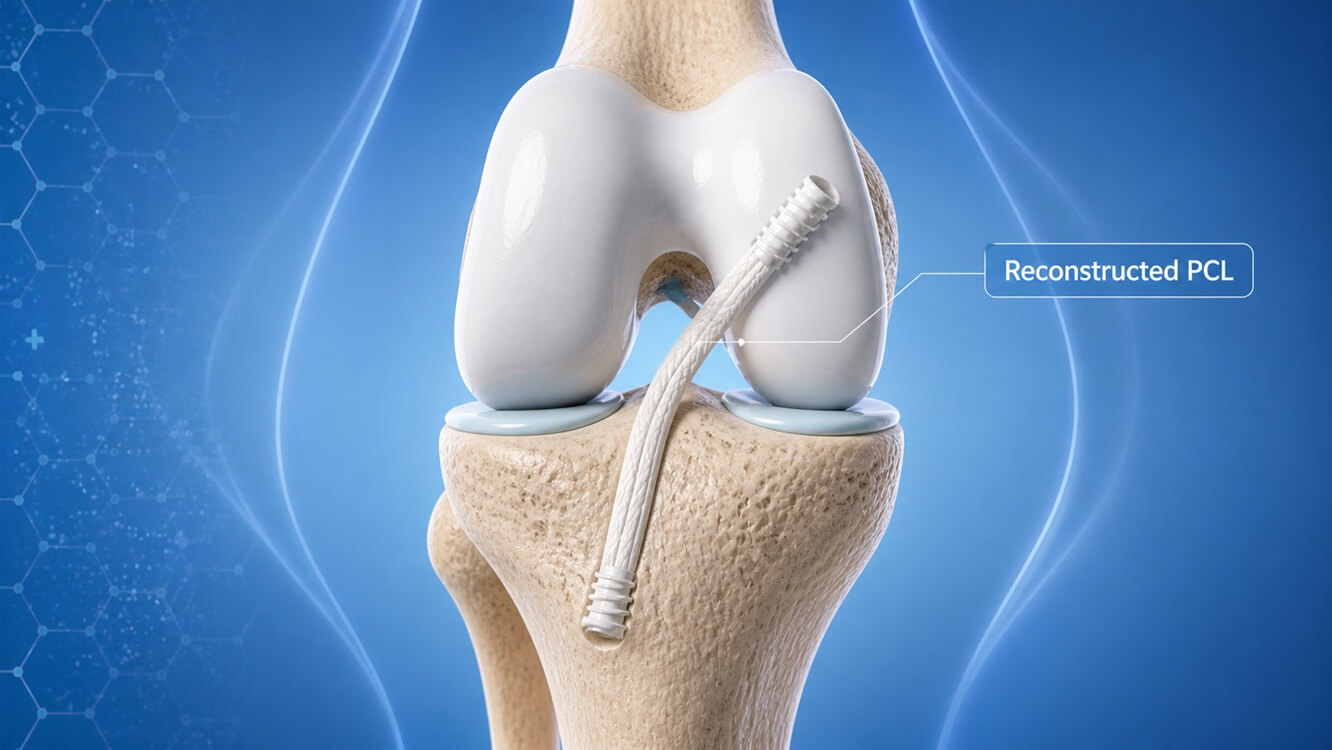
PCL reconstruction is a technically demanding arthroscopic procedure in which the torn ligament is replaced with a graft. Success depends on:

  • Accurate anatomic tunnel placement
  • Strong and reliable graft fixation
  • Protection of surrounding neurovascular structures

Graft Options in PCL Reconstruction

(1) Hamstring Tendon Graft

  • Commonly used (often doubled or tripled)
  • Adequate strength with minimal donor-site morbidity

Best suited for: Primary isolated PCL reconstruction

(2) Quadriceps Tendon Graft

  • Thick, robust graft with excellent biomechanical strength
  • Lower graft elongation compared to hamstrings

Best suited for: High-demand patients, revision surgery, and multi-ligament injuries

(3) Peroneus Longus Tendon Graft

  • Strong graft with excellent tensile strength
  • Minimal functional deficit at the ankle when harvested correctly
  • Provides sufficient length and diameter for PCL reconstruction

Best suited for:

  • Multi-ligament knee injuries
  • Patients with inadequate hamstring grafts
  • Revision ligament reconstructions

The peroneus longus graft has emerged as a reliable alternative autograft in complex knee ligament surgeries.

Synthetic Graft – Important Note

Synthetic ligaments are not routinely used as standalone grafts for PCL reconstruction.

Current role:

  • Augmentation of biological grafts
  • Revision surgeries
  • Situations where additional graft strength is required

Advantages:

  • Immediate tensile strength
  • No donor-site morbidity

Limitations:

  • Inferior biological incorporation compared to natural grafts
  • Long-term durability concerns if used alone

At ArthroSportz Med, synthetic grafts are used selectively as reinforcement, never as a compromise to long-term outcomes.

Fixation Implants

Due to the high forces across the PCL, secure fixation is critical:

  • Titanium or bio-absorbable interference screws
  • Suspensory fixation devices (Endobuttons)
  • Hybrid fixation techniques when required

Implant choice is individualized based on graft type, bone quality, and injury pattern.

Recovery & Rehabilitation

PCL rehabilitation is more protective and gradual than ACL rehabilitation.

  • Hospital stay: Day care / overnight
  • Brace: Functional PCL brace for 6–8 weeks
  • Weight bearing: Early, with brace support
  • Physiotherapy: Begins immediately
  • Return to desk work: 2–3 weeks
  • Jogging: ~4 months
  • Sports-specific training: 6–7 months
  • Return to sports: 9–12 months (after objective strength & stability assessment)

Why Choose ArthroSportz Med for PCL Reconstruction in Chennai?

At ArthroSportz Med,PCL reconstruction is performed with precision, planning, and purpose – aimed at restoring confidence, function, and long-term knee health.

Expertise in complex and multi-ligament knee injuries

Precision-based anatomic PCL reconstruction techniques

Thoughtful autograft selection, including peroneus longus when indicated

Integrated sports rehabilitation and physiotherapy

Focus on durable stability and long-term joint preservation

Restoring strength and mobility with trusted hands for over 10 years.

12+ Years of Care

Specialising in shoulder & knee care, arthroscopy, sports injuries, and trauma.

Joint & Sports Care

Frequently Asked Question

In most cases, you can begin physiotherapy without a doctor's referral; however, some insurance providers may require one for reimbursement or coverage purposes.

In most cases, you can begin physiotherapy without a doctor's referral; however, some insurance providers may require one for reimbursement or coverage purposes.

In most cases, you can begin physiotherapy without a doctor's referral; however, some insurance providers may require one for reimbursement or coverage purposes.

In most cases, you can begin physiotherapy without a doctor's referral; however, some insurance providers may require one for reimbursement or coverage purposes.

Source/s: Banner Image – AI Generated & is for representational purpose only.