Preloader

Superior Labral Tears

Superior Labral Tears_Banner

With advances in medical technology, many shoulder injuries that were difficult to diagnose in the past can now be accurately identified and treated. One such injury is a shoulder joint labral tear, also known as a glenoid labrum tear.

Using arthroscopic (keyhole) surgery, orthopaedic surgeons can now look inside the shoulder joint with a camera and treat labral injuries precisely, with minimal tissue damage and faster recovery.

Shoulder Anatomy – The Role of the Labrum

The shoulder is a ball-and-socket joint made up of:

  • Humerus (upper arm bone)
  • Scapula (shoulder blade)
  • Clavicle (collarbone)

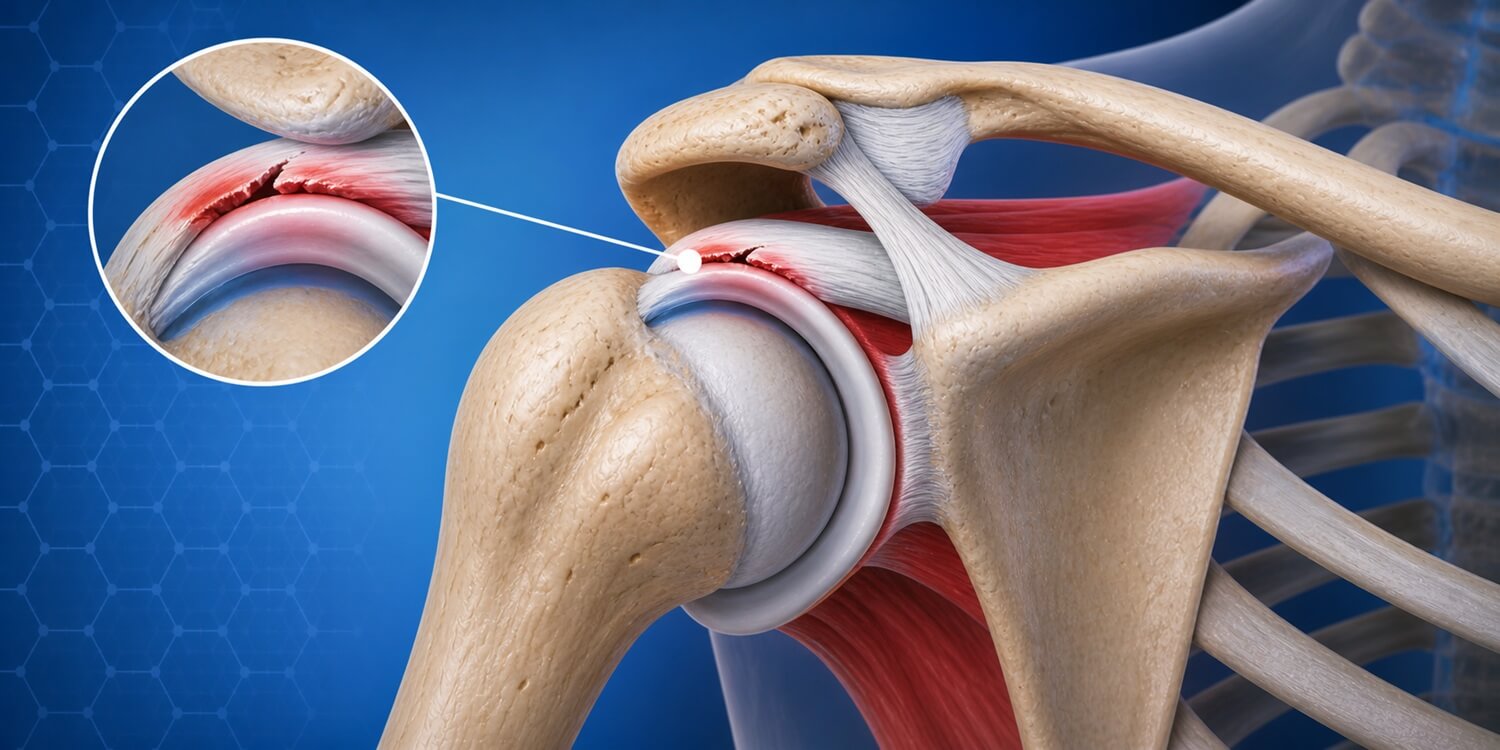
The head of the humerus sits in a shallow socket on the scapula called the glenoid. To improve stability, a rim of soft fibrous tissue called the labrum surrounds the socket.

Why the Labrum Is Important

  • Deepens the socket by up to 50%
  • Improves shoulder stability
  • Serves as an attachment for ligaments and the biceps tendon

Damage to the labrum can lead to pain, instability, and repeated shoulder dislocations.

Types of Labral Tears

There are several types of shoulder labral tears, depending on their location:

SLAP Tear

  • Superior Labrum Anterior to Posterior
  • Occurs at the top of the socket
  • Often involves the long head of the biceps tendon
  • Common in throwing athletes and overhead workers

Bankart Lesion

  • Tear of the front-inferior labrum
  • Usually occurs after an anterior shoulder dislocation
  • Common cause of recurrent shoulder instability

Posterior Labral Tear

  • Tear at the back of the socket
  • Can be due to trauma or age-related degeneration
  • Seen in contact sports or after seizures

Causes of Labral Tears

Labral injuries may result from acute trauma or repetitive shoulder use. Common Causes Include:

  • Fall on an outstretched arm
  • Direct blow to the shoulder
  • Sudden pulling or lifting of heavy objects
  • Violent overhead movement
  • Repetitive throwing or weightlifting

Athletes involved in cricket, tennis, swimming, weightlifting, and baseball are particularly at risk.

Symptoms of a Labral Tear

Symptoms may resemble other shoulder problems and include:

  • A feeling of instability or looseness in the shoulder
  • Recurrent shoulder dislocations
  • Pain, especially with overhead activities
  • Catching, locking, popping, or grinding sensations
  • Night pain or pain during daily activities
  • Reduced range of motion
  • Shoulder weakness

Doctor Evaluation & Diagnosis

Clinical Examination

Your doctor will:

  • Take a detailed injury history
  • Assess shoulder movement, strength, and stability
  • Perform special tests to provoke labral pain

Imaging Tests

  • X-rays: To rule out bone problems
  • MRI or CT scan (often with contrast): Helps identify labral tears and associated injuries

While imaging strongly suggests a labral tear, the definitive diagnosis is often confirmed during arthroscopic surgery.

Treatment Options for Superior Labral Tears

(1) Non-Surgical Treatment

Many labral tears can be treated without surgery:

  • Rest and activity modification
  • Anti-inflammatory medications
  • Physiotherapy to strengthen rotator cuff and shoulder blade muscles

If symptoms improve and the shoulder remains stable, surgery may not be required.

(2) Surgical Treatment

Surgery is considered when:

  • Symptoms persist despite conservative treatment
  • There is recurrent instability or dislocation
  • The tear involves the biceps tendon
  • The patient is young, active, or an athlete

(3) Arthroscopic Labral Repair

Most labral tears are treated using minimally invasive arthroscopic surgery. Depending on the tear:

  • Torn labral fragments may be trimmed
  • Labrum may be reattached using sutures or anchors
  • Biceps tendon may be repaired or repositioned if involved
  • In instability cases, the labrum and ligaments are tightened to restore joint stability

Not all labral tears are repairable. In such cases, non-surgical management may be recommended.

Recovery & Rehabilitation

  • Sling support for a short period (if required)
  • Gradual physiotherapy to restore movement and strength
  • Return to daily activities and sports based on tear type and repair
  • Full recovery may take 3–6 months, depending on the procedure

Why Choose ArthroSportz Med for Labral Tear Treatment in Chennai?

At ArthroSportz Med, we specialize in advanced shoulder arthroscopy and sports-related
shoulder injuries, offering comprehensive care from diagnosis to full recovery.

Our expertise:

Specialized care for SLAP tears, Bankart lesions, and shoulder instability

Advanced arthroscopic (keyhole) surgical techniques

Accurate diagnosis using high-quality imaging and clinical expertise

Individualized treatment—surgery only when truly necessary

Strong focus on athletes and active individuals

Structured post-operative rehabilitation for safe return to sports

Emphasis on long-term shoulder stability and function

Our goal is not just to treat the tear—but to restore confidence, strength, and stability in your shoulder.
Restoring strength and mobility with trusted hands for over 12 years.

12+ Years of Care

Specialising in shoulder & knee care, arthroscopy, sports injuries, and trauma.

Joint & Sports Care

Frequently Asked Question

In most cases, you can begin physiotherapy without a doctor's referral; however, some insurance providers may require one for reimbursement or coverage purposes.

In most cases, you can begin physiotherapy without a doctor's referral; however, some insurance providers may require one for reimbursement or coverage purposes.

In most cases, you can begin physiotherapy without a doctor's referral; however, some insurance providers may require one for reimbursement or coverage purposes.

In most cases, you can begin physiotherapy without a doctor's referral; however, some insurance providers may require one for reimbursement or coverage purposes.

Source/s: Banner Image – AI Generated & is for representational purpose only.