
Preloader

Arthroscopic Paralabral Cyst Decompression & Nerve Decompression

Arthroscopic Paralabral Cyst Decompression_Banner

What is a Paralabral Cyst?

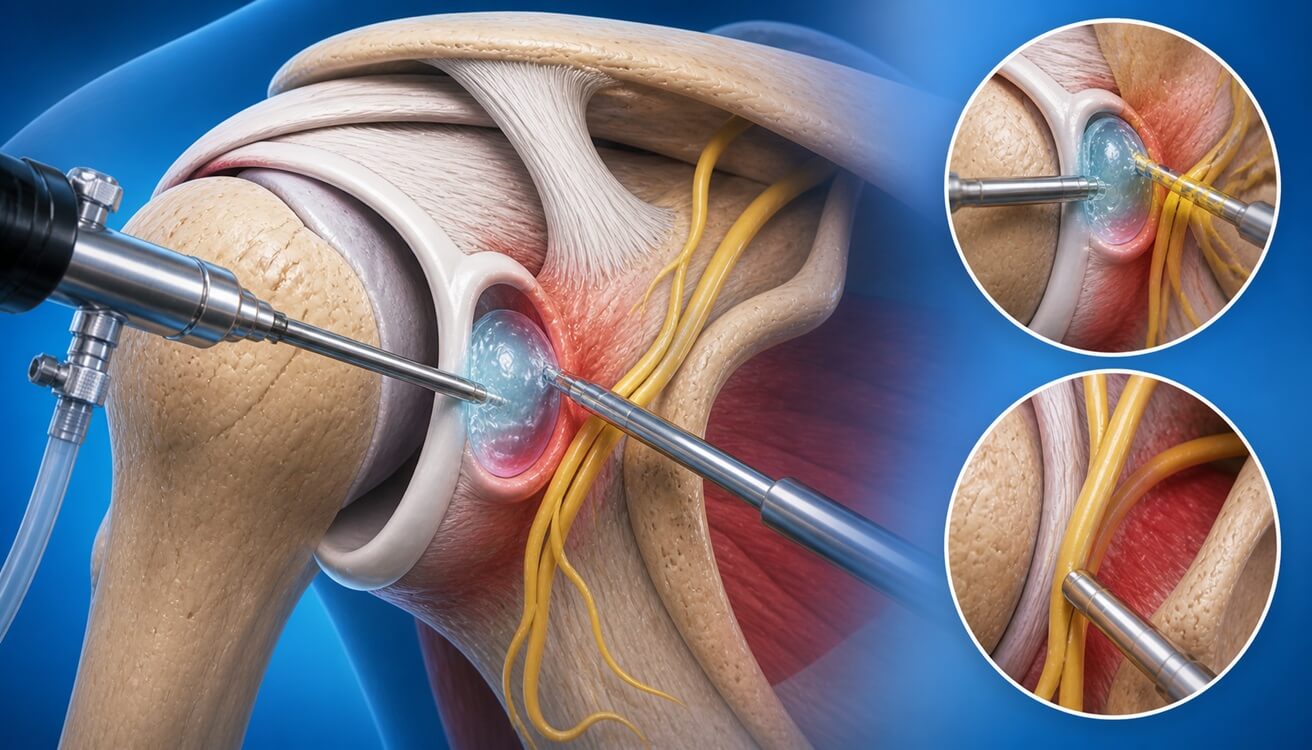
A paralabral cyst is a fluid-filled sac that forms next to the shoulder labrum (the cartilage rim of the socket). It usually develops because of an underlying labral tear, which allows joint fluid to leak out and collect as a cyst.

Over time, the cyst can press on nearby nerves, most commonly the suprascapular nerve, leading to pain, weakness, and muscle wasting.

Why Is Nerve Compression a Problem?

When a paralabral cyst compresses a nerve, patients may experience:

  • Deep shoulder pain (often at the back of the shoulder)
  • Weakness in lifting or rotating the arm
  • Loss of endurance or sports performance
  • Shrinking (atrophy) of shoulder muscles
  • Persistent symptoms despite physiotherapy or injections

⚠ If nerve compression is not treated early, weakness may become permanent.

What Happens in Biceps Tendinitis?

  • Early stage: The tendon becomes inflamed and swollen
  • Progressive stage: The tendon thickens due to continued irritation
  • Advanced stage: The tendon may fray or tear
  • Complete tear: Can cause a visible bulge in the arm called a “Popeye deformity”

Arthroscopic Paralabral Cyst Decompression – What Does It Mean?

This is a minimally invasive keyhole surgery performed using a camera (arthroscope) through tiny incisions.

What we do during surgery:

  • Identify and repair the labral tear causing the cyst
  • Decompress (drain) the cyst completely
  • Relieve pressure on the affected nerve
  • Restore normal shoulder mechanics

Simply aspirating (needle drainage) the cyst without fixing the labral tear often leads to recurrence. Arthroscopy treats the root cause, not just the swelling.

Arthroscopic Nerve Decompression

If the cyst has compressed the nerve significantly, direct nerve decompression is performed during the same arthroscopic procedure.

Benefits of arthroscopic nerve decompression:

  • Immediate relief of nerve pressure
  • Improved pain control
  • Gradual recovery of muscle strength
  • Prevention of long-term nerve damage
  • Avoids large open surgery

Who Needs This Surgery?

Arthroscopic cyst and nerve decompression is recommended when:

  • MRI shows a paralabral cyst with nerve compression
  • There is shoulder weakness or muscle wasting
  • Pain persists despite conservative treatment
  • The patient is an athlete or physically active
  • There is evidence of suprascapular nerve palsy

Recovery After Surgery

  • Sling for comfort for a short period
  • Early shoulder movements encouraged
  • Physiotherapy focused on strength recovery
  • Gradual return to sports and overhead activity

Expected recovery:

  • Pain relief: Early
  • Strength improvement: 6–12 weeks
  • Full functional recovery: 3–6 months (depending on nerve involvement)

Why Choose ArthroSportz Med for Arthroscopic Paralabral Cyst Decompression & Nerve Decompression?

Our Philosophy:
At ArthroSportz Med, paralabral cysts are not treated in isolation.

We identify the labral tear, decompress the cyst, relieve nerve pressure, and restore shoulder function—all in a single, minimally invasive procedure.

  • Early treatment protects the nerve.
  • Precise arthroscopy restores strength.
  • That’s the ArthroSportz Med difference.

Expertise in arthroscopic labral and nerve-related shoulder conditions

Advanced arthroscopic techniques for cyst and nerve decompression

Focus on treating the cause, not just the cyst

Special experience with athletes and overhead workers

Early diagnosis and nerve-preserving approach

Structured, personalised rehabilitation

Restoring strength and mobility with trusted hands for over 12 years.

12+ Years of Care

Specialising in shoulder & knee care, arthroscopy, sports injuries, and trauma.

Joint & Sports Care

Frequently Asked Question

In most cases, you can begin physiotherapy without a doctor's referral; however, some insurance providers may require one for reimbursement or coverage purposes.

In most cases, you can begin physiotherapy without a doctor's referral; however, some insurance providers may require one for reimbursement or coverage purposes.

In most cases, you can begin physiotherapy without a doctor's referral; however, some insurance providers may require one for reimbursement or coverage purposes.

In most cases, you can begin physiotherapy without a doctor's referral; however, some insurance providers may require one for reimbursement or coverage purposes.

Source/s: Banner Image – AI Generated & is for representational purpose only.