
Preloader

Arthroscopic SLAP Repair & Biceps Tenodesis

Arthroscopic SLAP Repair & Biceps Tenodesis_Banner

What Is a SLAP Tear?

A SLAP tear (Superior Labrum Anterior to Posterior tear) is an injury to the cartilage rim (labrum) at the top of the shoulder socket. This area is also where the long head of the biceps tendon attaches.

SLAP tears are commonly seen in:

  • Young athletes (throwing sports, cricket, tennis, swimming)
  • People with falls or traction injuries
  • Repetitive overhead work
  • Shoulder instability or dislocations

Common symptoms:

  • Deep shoulder pain (especially with overhead activity)
  • Clicking, catching, or locking
  • Weakness or reduced sports performance
  • Pain when lifting or throwing

Arthroscopic SLAP Repair – What Does It Involve?

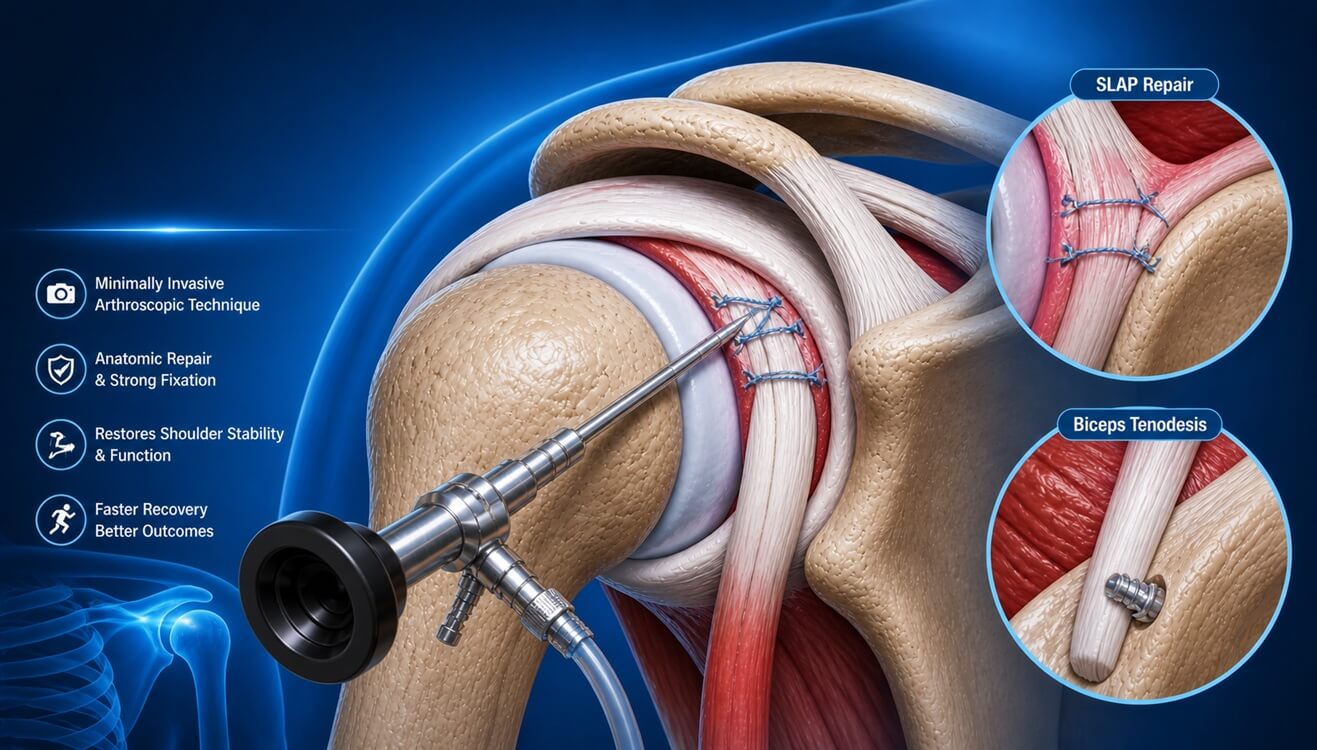
Arthroscopic SLAP repair is a minimally invasive keyhole surgery performed using a small camera and fine instruments.

How the surgery is done:

  • The torn labrum is visualised clearly using arthroscopy
  • The damaged labrum is reattached to bone using small suture anchors
  • Normal shoulder anatomy and stability are restored

Benefits of arthroscopic SLAP repair:

  • Very small incisions and minimal scarring
  • Less post-operative pain
  • Accurate and anatomical repair
  • Faster rehabilitation
  • Excellent outcomes in young, active patients

SLAP repair is usually recommended for:

  • Young patients
  • Athletes involved in overhead sports
  • Stable shoulders with good tissue quality

Arthroscopic Biceps Tenodesis – An Alternative Solution

In many patients, especially adults, the biceps tendon itself is the main source of pain rather than the labrum.

In such cases, arthroscopic biceps tenodesis may provide better and more predictable relief.

What is Biceps Tenodesis?

  • The painful portion of the biceps tendon is released from the shoulder socket
  • The tendon is then securely fixed to the upper arm bone (humerus)
  • This removes pain while preserving strength and appearance

Benefits of biceps tenodesis:

  • Excellent pain relief
  • Maintains arm strength
  • Avoids repeated labral stress
  • Faster and more reliable recovery in many adults
  • No cosmetic “Popeye” deformity (unlike tenotomy)

Biceps tenodesis is commonly advised for:

  • Patients over 35–40 years
  • Degenerative SLAP tears
  • Failed SLAP repairs
  • Associated rotator cuff tears
  • Biceps tendon inflammation or fraying

SLAP Repair vs Biceps Tenodesis – How We Decide

At ArthroSportz Med, surgery is individualised, not routine. We consider:

  • Age
  • Activity level and sports demands
  • Type and extent of labral tear
  • Condition of the biceps tendon
  • Associated shoulder problems
  • Patient expectations

👉 Young athletes → Arthroscopic SLAP repair
👉 Middle-aged or older patients → Arthroscopic biceps tenodesis
👉 Complex cases → Combination or tailored approach

Recovery & Rehabilitation

  • Sling support initially
  • Early guided shoulder movements
  • Gradual strengthening
  • Sports-specific rehab when required

Return to activity:

  • Daily activities: 2–4 weeks
  • Strength recovery: 8–12 weeks
  • Sports / overhead activity: 3–6 months

Why Choose ArthroSportz Med for Arthroscopic SLAP Repair & Biceps Tenodesis?

Not every SLAP tear needs the same surgery.

At ArthroSportz Med, we choose the procedure that gives you the best chance of lasting pain relief, strength, and return to activity.

Because the right surgery — done arthroscopically, for the right patient — makes all the difference
Expertise in arthroscopic shoulder surgery

Special focus on athletes and active individuals

Evidence-based decision-making (repair vs tenodesis)

Advanced arthroscopic implants and techniques

Emphasis on pain relief and long-term function

Structured, personalised rehabilitation programs

Restoring strength and mobility with trusted hands for over 12 years.

12+ Years of Care

Specialising in shoulder & knee care, arthroscopy, sports injuries, and trauma.

Joint & Sports Care

Frequently Asked Question

In most cases, you can begin physiotherapy without a doctor's referral; however, some insurance providers may require one for reimbursement or coverage purposes.

In most cases, you can begin physiotherapy without a doctor's referral; however, some insurance providers may require one for reimbursement or coverage purposes.

In most cases, you can begin physiotherapy without a doctor's referral; however, some insurance providers may require one for reimbursement or coverage purposes.

In most cases, you can begin physiotherapy without a doctor's referral; however, some insurance providers may require one for reimbursement or coverage purposes.

Source/s: Banner Image – AI Generated & is for representational purpose only.